Rep. Lateefah Simon’s federal bill would expand funding eligibility for unarmed transit ambassador-style safety programs
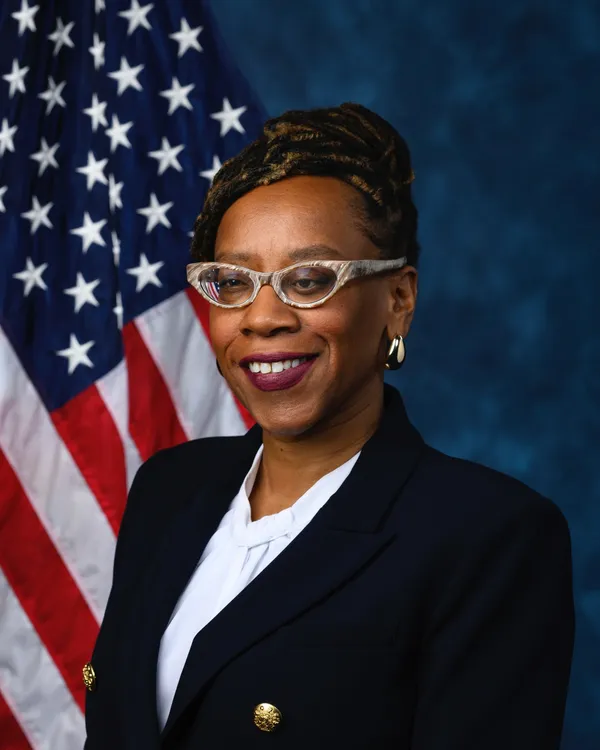
A push to scale a BART-style model through federal grant rules
U.S. Rep. Lateefah Simon, a former BART Board president, has introduced federal legislation designed to make “transit support specialists” eligible for federal crime-prevention and security funding. The proposal, filed as H.R. 6069 in the 119th Congress, would amend federal transit law to explicitly include unarmed personnel—such as ambassador teams—within the categories that can be supported by certain security-related grants.
The bill was introduced on Nov. 17, 2025, and referred the next day to the House Transportation and Infrastructure Committee’s Subcommittee on Highways and Transit. As of early February 2026, it remains at the introductory stage in the legislative process.
What the bill would do
H.R. 6069 would modify Section 5321 of Title 49 of the U.S. Code, the federal provision governing crime-prevention and security assistance for public transportation. The central change is to ensure that transit systems can use certain federal funds for operational support of “transit support specialists,” in addition to traditional security uses.
The bill also creates a statutory definition of “transit support specialist” as unarmed personnel tasked with providing an added sense of security through visible presence and engagement. The definition includes duties such as monitoring stations and vehicles, assisting riders and staff, responding to and reporting medical emergencies, observing and reporting suspicious activity, de-escalating minor conflicts through non-police channels, and connecting patrons with crisis-intervention services.
How it relates to BART’s ambassador program
BART’s ambassador program began as a pilot in February 2020, built around unarmed, uniformed staff recruited from BART Police Department Community Service Officers. The program was created to increase visible presence on trains, provide customer assistance, and serve as additional “eyes and ears” for safety concerns while reserving sworn officers for enforcement and emergencies. Ambassadors were assigned to ride trains in teams and were trained in de-escalation and anti-bias practices.
The approach reflects a broader trend in transit agencies toward layered safety strategies that combine customer-service-oriented staff, specialized crisis response capacity, and law enforcement for higher-risk incidents.
Policy questions likely to shape the debate
Operational funding and accountability: Expanding eligibility for operating support raises questions about performance measures—such as rider perceptions of safety, response protocols, and coordination with police and emergency services.
Role clarity: The proposal codifies a wide range of responsibilities for unarmed specialists, making training standards, supervision, and limits on duties central to program design.
Local control versus federal criteria: Transit systems vary widely in staffing models; a federal definition could encourage consistency while still leaving implementation to local agencies.
For Bay Area riders, the measure places a BART-tested concept into a national policy framework—less by “nationalizing” a specific local program than by changing who can qualify for federal support when agencies choose to deploy unarmed, visible safety and assistance staff.